Articles & Analysis
Insights
Perspectives on AI governance, the EU AI Act, digital health policy, clinical AI oversight and healthcare innovation.
Most Hospitals Cannot Demonstrate Oversight of Their Clinical AI Systems
Analysis of why hospitals may require a Clinical AI Registry to establish governance oversight of high-risk AI systems under the EU AI Act.
Read MoreThe 7 AI Governance Questions Every Hospital Board Should Ask
A strategic guide for hospital boards, CIOs, and healthcare leadership on the essential governance questions required to oversee artificial intelligence systems under the European Union Artificial Intelligence Act.
Read MoreClinical AI Governance: A Practical Guide for Hospitals
A comprehensive guide for healthcare leadership on establishing governance frameworks for artificial intelligence systems in clinical environments, covering regulatory requirements, risk classification, oversight structures, and implementation roadmaps.
Read MoreClinical AI Governance in Hospitals: Preparing for the European AI Regulatory Era
Clinical AI governance is becoming essential for hospitals deploying artificial intelligence systems. Learn how healthcare organisations can prepare for EU AI Act requirements and build responsible oversight frameworks.
Read MoreClinical AI Governance in Hospitals: Why Healthcare Needs an AI System Registry
Hospitals deploying AI systems require structured governance. This article explains why clinical AI registries are essential for oversight, documentation and lifecycle monitoring.
Read MoreEU AI Act Governance Readiness for Hospitals
Preparing Clinical AI Systems for the European Regulatory Framework. An executive briefing for hospital leaders evaluating governance readiness as the EU AI Act introduces new obligations for healthcare organisations deploying AI systems.
Read MoreThe EU AI Act and the Governance Challenge for Hospitals
Why healthcare organisations must begin preparing governance structures for clinical artificial intelligence.
Read MoreWhy AI Governance Is Emerging as a Critical Challenge in Healthcare
Artificial intelligence is transforming clinical practice at an unprecedented pace. Understanding why governance frameworks are now essential requires examining the long history of how technology and regulation have evolved together.
Read MoreTechnological Acceleration and Regulatory Response
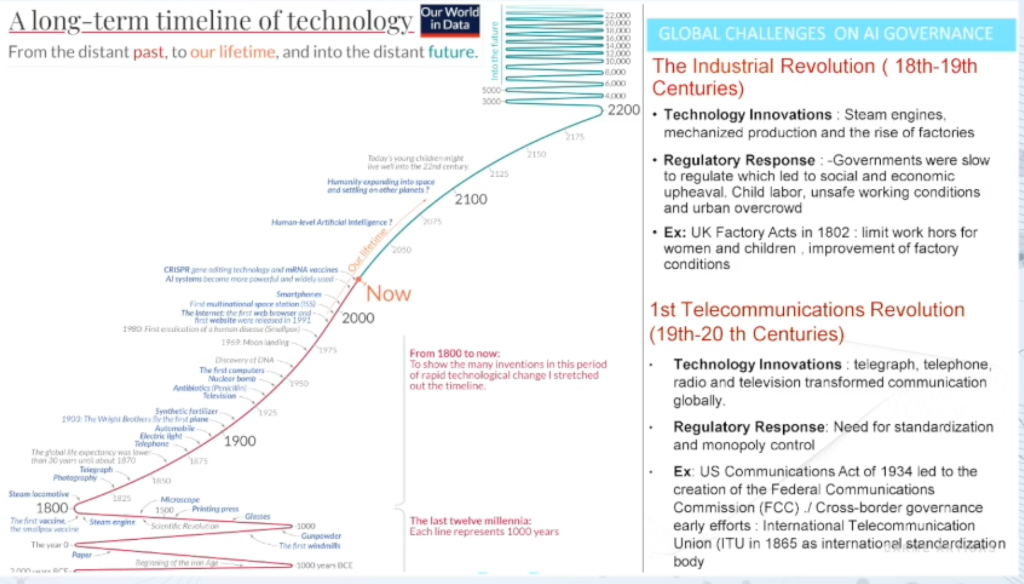
Long-term technological progress has repeatedly required new governance and regulatory frameworks. Artificial intelligence represents the latest phase of technological transformation affecting healthcare systems.
View AI Governance ResourcesAI Governance in Hospitals: Preparing for the EU AI Act
As the European Union Artificial Intelligence Act moves toward implementation, hospitals deploying clinical AI systems must begin establishing governance structures. This article examines the key regulatory expectations and practical steps healthcare organisations should consider.
Read MoreWhy Clinical AI Requires Institutional Oversight
The increasing use of artificial intelligence in diagnostics, triage and clinical decision support raises fundamental questions about accountability and patient safety. Institutional oversight frameworks are essential to ensure that AI tools meet the standards expected of clinical practice.
Read MoreThe Governance Gap in Healthcare Artificial Intelligence
While AI adoption in healthcare accelerates, many organisations lack the governance infrastructure needed to manage these systems responsibly. This article explores the governance gap and outlines how healthcare organisations can begin to address it.
Read MoreFrom LinkedIn
AI governance in healthcare is no longer optional — it is a legal obligation. The EU AI Act classifies most clinical AI systems as high-risk. That means hospitals must now have documented conformity assessments, human oversight protocols, post-market surveillance plans, and clear accountability structures in place. Yet most hospitals I speak with have no inventory of the AI systems currently run…
Three questions every hospital board should be able to answer about clinical AI: 1. What AI systems are currently deployed in your clinical environment? 2. Who is the designated responsible person for each system? 3. What is your process when an AI system fails or produces an unexpected output? If the answer to any of these is “we don’t know” — you have a governance problem, not a technology pro…
The conversation about AI in healthcare is dominated by capability — what AI can do. The conversation that needs to happen is about governance — what structures must exist before AI should be deployed. Clinical AI systems can improve diagnostics, streamline workflows, and support decision-making. But without oversight frameworks, accountability structures, and continuous monitoring, they also in…