The EU AI Act and the Governance Challenge for Hospitals
By Dr Rebindrenath R. Goerdin
Founder — Lifecycle Governance™
Initiator — Clinical AI Registry™
Why healthcare organisations must begin preparing governance structures for clinical artificial intelligence.
Artificial intelligence is increasingly present in healthcare settings. Diagnostic imaging analysis tools, clinical triage systems, decision support applications and workflow optimisation software are being adopted by hospitals and healthcare organisations across Europe and internationally.
These technologies promise to improve efficiency, reduce diagnostic error and support clinical staff in environments of increasing demand. Yet alongside these opportunities, the deployment of AI in healthcare introduces governance challenges that many organisations are only beginning to recognise.
Framework
The Clinical AI Governance Lifecycle
The EU AI Act Changes the Landscape
The European Union Artificial Intelligence Act introduces a risk-based regulatory framework for AI systems deployed across all sectors, including healthcare. For the first time, organisations deploying AI technologies face legal obligations relating to transparency, documentation, human oversight and risk management.
The Act establishes categories of AI risk — from minimal to unacceptable — with the most stringent obligations applying to systems classified as high-risk. Organisations that deploy high-risk AI systems must implement governance structures, maintain documentation, conduct conformity assessments and ensure ongoing human oversight of these systems.
Healthcare and High-Risk AI
Many AI applications deployed in clinical environments may fall under the high-risk classification established by the EU AI Act. Diagnostic decision support tools, clinical triage systems and imaging analysis applications that inform or influence clinical decisions are examples of technologies that may require compliance with the Act's high-risk provisions.
The rationale is clear: where AI systems are used in contexts that affect patient safety, clinical decision-making or access to healthcare, the potential consequences of failure are significant. Regulatory frameworks are designed to ensure that organisations deploying these technologies maintain appropriate oversight and accountability.
Lessons from Previous Technological Revolutions
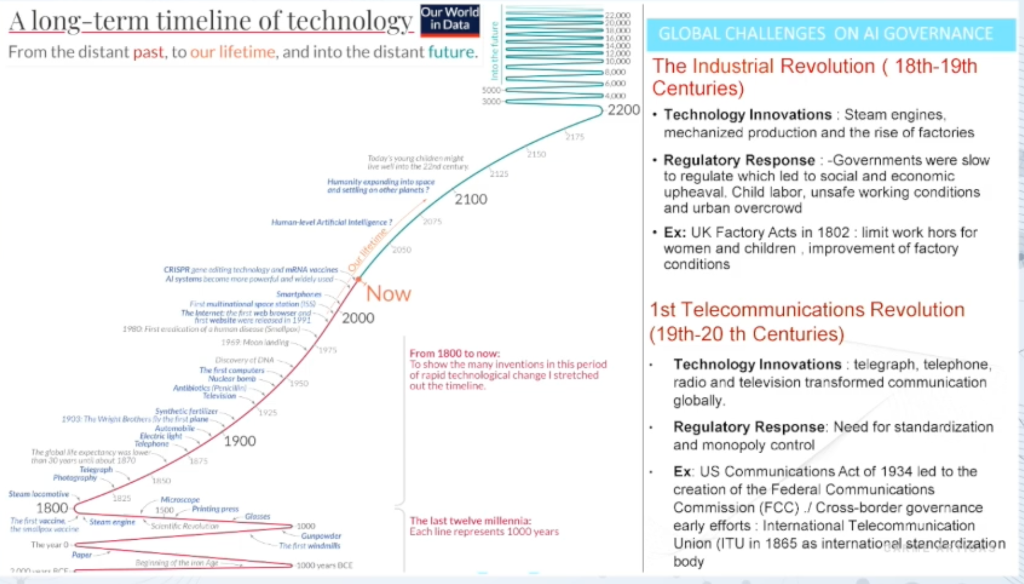
The governance challenges posed by artificial intelligence are not entirely without precedent. Each major wave of technological transformation — the Industrial Revolution, the telecommunications era, the digital revolution — has eventually required institutional responses in the form of new standards, regulatory bodies and legal frameworks.
The pattern is consistent: technology advances rapidly, deployment outpaces governance, and institutions eventually respond with oversight structures designed to manage risk and protect public interests. Artificial intelligence represents the latest phase of this pattern.
The Governance Gap in Healthcare
Despite the rapid expansion of AI tools in clinical environments, many healthcare organisations lack the governance structures required to oversee these systems. AI technologies are frequently piloted, procured and deployed without the systematic frameworks needed to manage their ongoing operation, performance monitoring and compliance obligations.
This governance gap is not simply a compliance risk. It represents an organisational vulnerability — a situation in which institutions are increasingly dependent on systems they do not have the structures to properly oversee.
What AI Governance Might Look Like
Effective AI governance in healthcare organisations may include a range of structural elements:
- —Oversight committees responsible for reviewing, approving and monitoring AI system deployments
- —Risk management frameworks for identifying and assessing the potential harms associated with specific AI applications
- —Documentation systems that maintain records of AI systems throughout their operational lifecycle
- —Monitoring processes that track AI system performance, incidents and outcomes over time
- —Staff training structures that ensure clinical personnel understand the capabilities and limitations of AI tools they use
These elements do not necessarily require new institutions. In many cases, existing governance structures — clinical governance committees, risk management teams, information governance functions — can be extended to encompass AI oversight.
Governance Infrastructure
For hospitals and healthcare organisations deploying AI at scale, the individual components of governance need to be supported by coherent infrastructure. Ad hoc approaches to individual AI systems are unlikely to be sufficient as AI deployment becomes more widespread.
Lifecycle Governance™ provides a framework designed to support hospitals in establishing governance infrastructure for clinical AI systems. The framework addresses the full lifecycle of AI deployment — from procurement and implementation through to ongoing monitoring and eventual decommissioning — providing the structures organisations need to meet their regulatory obligations and maintain appropriate clinical oversight.
Conclusion
Artificial intelligence governance will become an institutional responsibility within healthcare organisations. As AI systems become embedded in clinical workflows and regulatory frameworks mature, the organisations best positioned will be those that have established governance structures before deployment rather than after.
The question for hospital leadership is not whether to engage with AI governance, but how and when to begin.
Request an Executive AI Governance Briefing
Hospitals evaluating clinical AI systems may benefit from a concise governance readiness discussion.
Request Executive BriefingRelated Resources